
The hidden cost of incident time
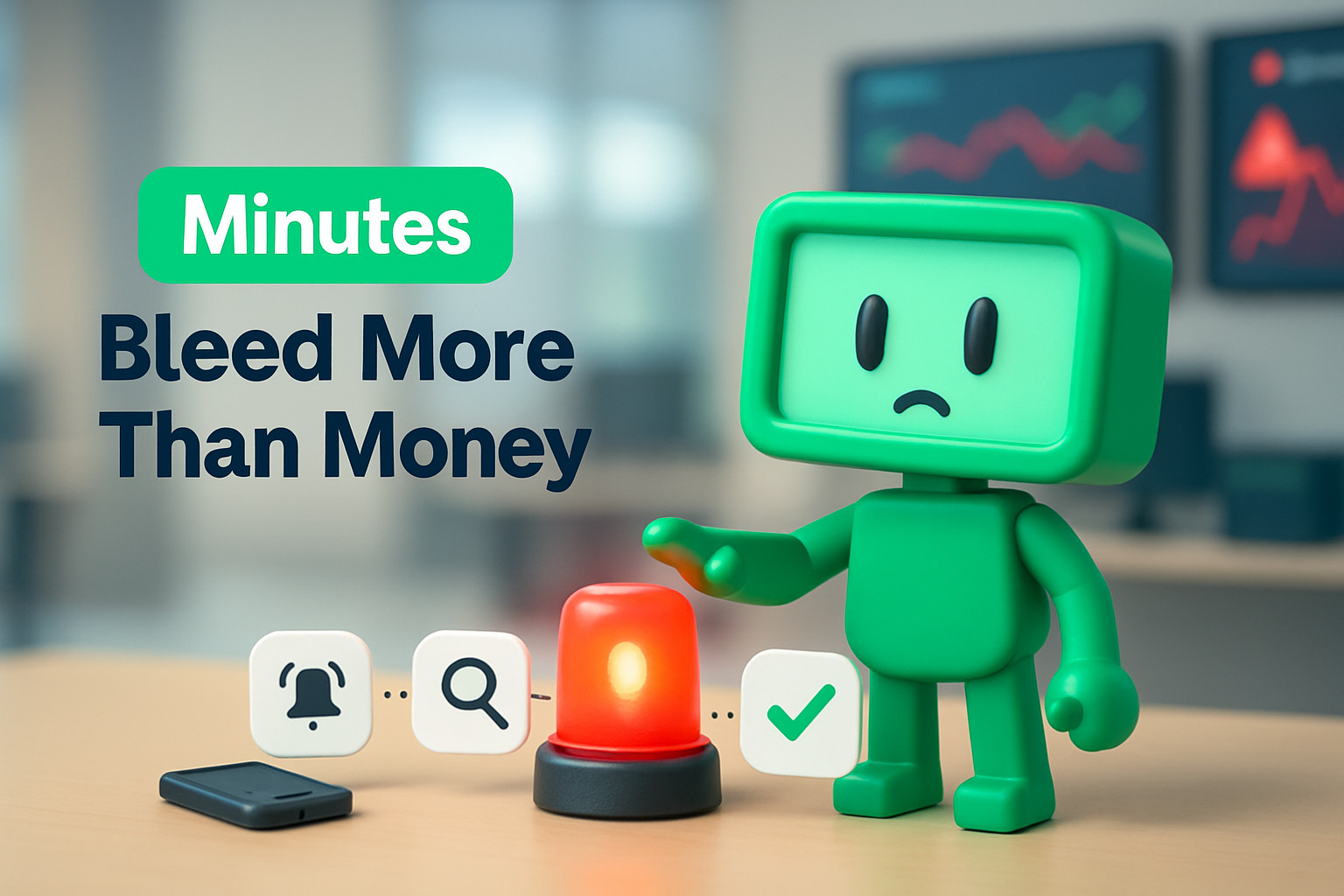
Most teams can tell you their uptime target. Far fewer can tell you how much engineering time disappears when that target breaks. That gap matters because incidents are not only reliability events; they are capacity events.
An outage has a visible timeline: detected at 10:04, mitigated at 10:41, resolved at 11:18. The invisible timeline starts earlier and ends later. It includes the engineer pulled out of a design review, the manager rewriting the roadmap, and the senior developer spending the afternoon reconstructing what happened.
Teams often treat incident response as a tax they have already accepted. They staff on-call, write runbooks, and move on. But a tax you never measure becomes a blank check against developer productivity.
The real question is not whether incidents happen. They will. The question is whether your team knows the incident cost well enough to reduce it without pretending resilience comes for free.
Measure the hours, not just the minutes
MTTR is useful, but it is incomplete. A 30-minute incident can consume 40 hours of engineering time if enough people are pulled into the room. The clock on the customer impact is not the same as the clock on the team impact.
Start by counting people and time, not only alerts and severity. Who joined the incident channel? Who investigated, communicated, approved, deployed, verified, and wrote the post-incident review? Each role has a cost even when the incident looks short on a dashboard.
A simple model is better than no model. Multiply the number of responders by the time they spent actively involved, then add recovery time for interrupted work. If five engineers spend two hours on the incident and another hour regaining context, the incident cost is not two hours; it is fifteen engineering hours.
Do not ignore managers, support engineers, and product leads. During a serious outage, they absorb customer pressure, coordinate updates, and make prioritization calls. That work is necessary, but it still comes out of the same organizational capacity.
The goal is not accounting theater. The goal is to make tradeoffs visible. Once incident cost is expressed in engineering time, reliability work stops competing with product work in vague terms and starts competing on measurable economics.
Where engineering time disappears
The first loss is detection delay. Every minute spent wondering whether an alert is real extends the outage and increases the number of people who get involved. Unclear ownership turns a technical problem into a coordination problem.
The second loss is responder sprawl. Teams invite more people because they lack confidence in the diagnosis. More eyes can help, but unmanaged escalation often creates a crowded room where five engineers wait while one person types.
The third loss is context switching. An engineer pulled from feature work does not resume at full speed after the incident channel goes quiet. Complex work has a warm-up cost, and incidents reset that clock repeatedly.
The fourth loss is communication overhead. Status updates, stakeholder pings, customer questions, and executive escalations all compete with diagnosis. When communication has no owner, your best technical responders become part-time broadcasters.
The fifth loss is post-incident drag. Teams schedule a review, search through logs, debate timelines, write action items, and then negotiate who owns them. That work is valuable, but it becomes waste when the same failure mode returns next month.
Why incident cost compounds
The direct hours are only the surface. Repeated incidents create an on-call burden that changes how engineers plan their work and their lives. People avoid deep tasks when they expect to be interrupted.
This is where developer productivity gets misread. A team may look fully staffed and still operate below capacity because the best engineers are constantly pulled into reactive work. The backlog grows, not because people are slow, but because attention is fragmented.
Chronic incidents also distort technical decision-making. Engineers choose safer, smaller changes because they fear waking the rotation. That caution can be rational, but over time it turns reliability pain into product drag.
The cultural cost is harder to quantify, but leaders feel it. Teams stop trusting systems, handoffs, and alerts. Once trust drops, every deployment carries more ceremony and every incident attracts more spectators.
Compounding cost is why a low-severity incident can still deserve leadership attention. Severity labels describe customer impact, not organizational waste. A recurring minor outage can consume more engineering time than one dramatic failure.
Reduce the cost before you reduce the count
Many leaders start by asking how to have fewer incidents. That is the right long-term question, but it is not always the fastest lever. First, reduce the amount of time each incident extracts from the team.
Clear ownership is the highest-return move. Every service needs an accountable team, every alert needs a responder, and every escalation path needs to be obvious before the pager fires. Ambiguity is expensive under pressure.
Standardize the incident roles. One person leads, one investigates each major hypothesis, one handles communication, and one tracks decisions and timestamps. This structure feels heavy only to teams that have not counted the cost of improvisation.
Protect responders from unnecessary noise. Keep stakeholders informed through a dedicated channel or owner rather than letting every question interrupt the diagnosis. The fastest incident rooms are not the loudest; they are the clearest.
Close the loop with action items that remove future toil. A post-incident review should not become a ritual for recording regret. It should produce fewer pages at 3 a.m., faster diagnosis, and less engineering time lost the next time something breaks.
Final thoughts
Incidents are often discussed as reliability failures, but leaders should also treat them as capacity leaks. Every hour spent coordinating confusion is an hour not spent improving the product. That does not make incident work less important; it makes the cost impossible to ignore.
If you cannot estimate the engineering time lost during incidents, you cannot honestly prioritize reliability work. You are left with anecdotes, frustration, and the loudest recent outage. That is not strategy.
The strongest teams do not aim for a world without incidents. They aim for incidents that are detected quickly, owned clearly, communicated cleanly, and converted into durable improvements. That is how reliability work protects developer productivity instead of competing with it.
Measure the cost in hours, not just severity. Track who was involved, how long they were pulled away, and what work slipped as a result. Then use that data to reduce the on-call burden with the same discipline you apply to latency or error rates.
The hidden cost of incidents is not the outage itself. It is the engineering organization learning to accept avoidable interruption as normal. The teams that win are not the ones with the fewest surprises; they are the ones that waste the least time when surprises arrive.