
Why incident response is an engineering productivity problem
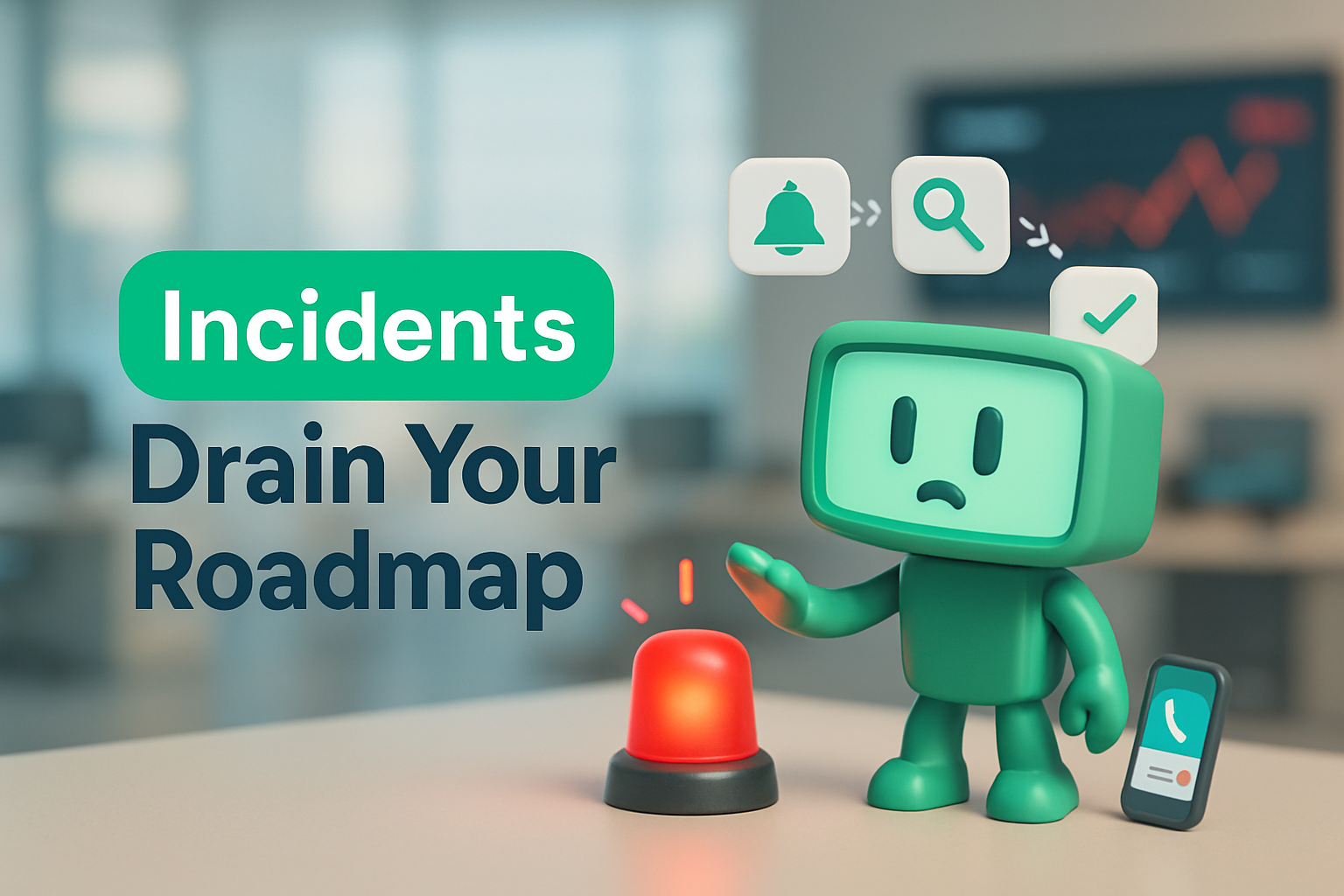
The most expensive incident is not always the one with the longest outage. It is the one that teaches your team to stop trusting its calendar.
Most leaders treat incident response as a reliability function. That is true, but incomplete. Incident response is also an engineering productivity problem, because every escalation competes with planned work, design reviews, hiring loops, and product delivery.
A five-minute page rarely costs five minutes. It fractures attention, pulls context from another system, and forces an engineer to rebuild the mental model they were using before the alert arrived.
The question is not whether incidents matter. They do. The sharper question is whether your incident management process protects developer time, or quietly converts your best engineers into full-time coordinators of avoidable chaos.
Incidents consume capacity before they cause outages
Engineering teams often account for incidents only when customers feel pain. That misses the earlier drain. Long before an outage becomes public, people are investigating noisy alerts, chasing ambiguous ownership, and interrupting roadmap work.
This is why incident cost is underreported. A failed deploy may take thirty minutes to roll back, but the surrounding work can consume half a day across five people. The calendar shows meetings and tickets; the real loss is fragmented attention.
Developer time is not interchangeable inventory. An hour taken from a senior engineer during deep design work is not the same as an hour moved from a routine queue. Some interruptions erase work that was never written down.
DevOps culture taught teams to own what they build. That principle improved accountability, but it also moved operational load closer to product teams. Without guardrails, ownership becomes a tax on the very teams expected to ship faster.
A mature organization does not ask whether incidents are inevitable. They are. It asks how much productive capacity is being reserved, burned, or wasted by the way the team responds to them.
On-call is a system, not a sacrifice
Many teams still treat on-call as a rite of passage. Engineers rotate through pain, learn the scars of the system, and emerge with tribal knowledge. That sounds practical until the same knowledge never becomes documentation, automation, or design change.
Good on-call is not heroism. It is a system for routing the right signal to the right person with enough context to act quickly. If the person receiving the page must become a detective before they can become an operator, the system is broken.
The burden is not distributed just because the schedule rotates. Some services are noisier, some teams own more fragile dependencies, and some engineers are better at absorbing ambiguity. Equal rotation can still produce unequal damage.
Leaders should ask uncomfortable questions about operational load. Who gets paged most often after hours? Which teams lose the most sprint capacity to incident management? Which alerts have trained people to ignore the pager?
Protecting on-call health is not a perk. It is capacity planning. If a team is exhausted by the systems it owns, its delivery estimates are fiction and its reliability roadmap is already behind.
Measure the work that incidents displace
Many reliability dashboards stop at uptime, alert volume, and mean time to resolution. Those metrics matter, but they do not show what the organization gave up to achieve them. A team can hit its uptime target while missing its product commitments.
Engineering productivity requires measuring displacement. How many roadmap hours were interrupted? How many planned tasks slipped because the same engineers were pulled into response? How often did incident follow-up compete with feature delivery?
This does not mean turning every interruption into a spreadsheet exercise. It means making the hidden cost visible enough to change decisions. If incidents are repeatedly consuming the same team, the answer may be architecture, staffing, ownership, or alert design.
Postmortems should capture more than root cause and remediation. They should record coordination friction, missing context, unclear escalation paths, and time spent waiting for the right person. Those are productivity defects, not administrative details.
The best incident reviews create two kinds of learning. One reduces the chance of recurrence. The other reduces the human effort required when recurrence still happens.
Design incident management around flow
The instinct during incidents is to add more process. More channels, more roles, more checklists, more meetings. Process helps only when it reduces cognitive load; otherwise it becomes another surface area to manage under stress.
Incident management should preserve flow wherever possible. The responder needs context, ownership, runbooks, recent changes, dependencies, and customer impact in one path of action. Every extra lookup is another chance for delay and confusion.
Coordination should be explicit before the outage begins. Who leads? Who communicates? Who makes rollback decisions? If those answers are negotiated during the incident, you have converted technical failure into organizational drag.
Automation is useful when it removes predictable toil, not when it hides judgment. Auto-routing, service ownership mapping, and templated updates can save time. Blind suppression or noisy enrichment can create false confidence and slower recovery.
The goal is not to make incidents feel effortless. The goal is to stop each incident from becoming a bespoke management exercise. Repeatable response protects both reliability and the engineering focus required to improve the product.
Final thoughts
Incident response will always require urgency. The mistake is allowing urgency to excuse waste. A team that burns ten engineers to resolve what two informed engineers could handle is not moving fast; it is spending capacity badly.
Reliability work and product work are often framed as competitors. That framing is convenient, but wrong. Better incident response gives product teams back the uninterrupted time they need to build durable systems.
Engineering managers should treat recurring incidents like recurring meetings with no agenda. Both consume attention, both create switching costs, and both become normal when no one prices them honestly. What becomes normal becomes invisible.
The strongest teams do not celebrate firefighting as culture. They study the fire, remove the fuel, and redesign the response so fewer people need to run toward it next time. That is how operational maturity turns into delivery capacity.
Incident response is not a break from engineering productivity. It is one of the places where engineering productivity is either protected or destroyed.